
Energy giant TotalEnergies has officially launched operations at an advanced plastic recycling facility located at the Grandpuits industrial site, southeast of Paris. With an annual capacity of around 15,000 tonnes, the plant is considered the first large-scale pyrolysis facility of its kind in France, marking a significant milestone in transforming a traditional oil refinery into a complex no longer reliant on crude oil.
The project uses technology developed by Plastic Energy, enabling the treatment of hard-to-recycle plastic waste that would otherwise be sent to landfill or incineration. Feedstock supply is secured through a long-term agreement signed in 2023 with partners such as Citeo and Paprec. This combination of advanced technology and a stable supply chain reflects France’s ambition to industrialize plastic recycling.
At the same time, TotalEnergies has partnered with Holcim to commission a 31 MW floating solar power plant in Belgium. Built on a rehabilitated former chalk quarry that has been converted into a lake, the facility generates approximately 30 GWh of renewable electricity annually to supply nearby industrial operations. This highlights a broader strategy that integrates material recycling with renewable energy development.
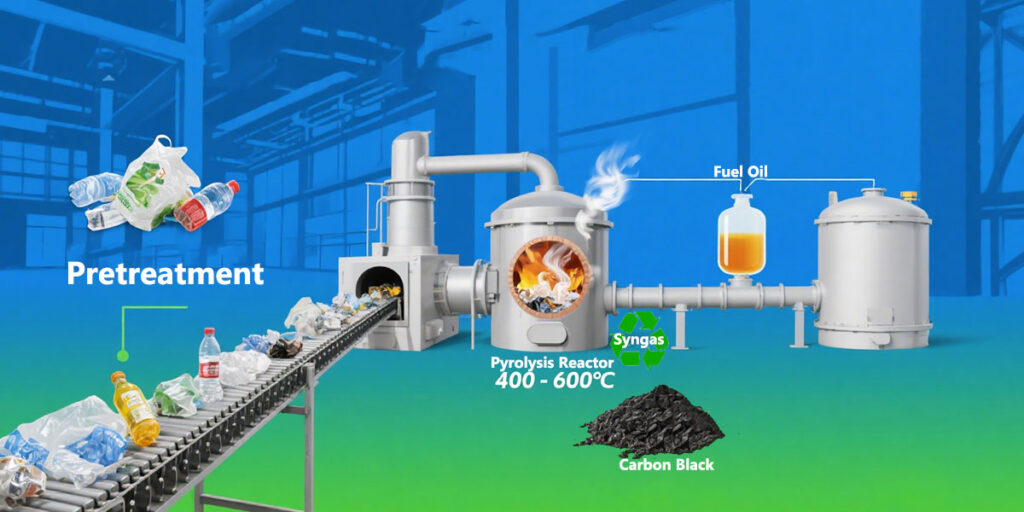
Pyrolysis is a thermal decomposition process carried out in the absence of oxygen, where plastic waste is heated at high temperatures to break down polymer structures. The process produces a synthetic oil that can be refined and reused as feedstock in petrochemical production or for manufacturing new plastics. Unlike mechanical recycling, which is limited by material purity and consistency, pyrolysis can handle mixed, contaminated, or degraded plastics.
The concept of pyrolysis is not new. The principle of decomposing materials through heat in oxygen-free conditions dates back to the 19th century, initially used in coal processing and gas production. Research into plastic pyrolysis began in the 1970s during the global energy crisis, when alternative fuel sources were being explored. However, it is only in the past decade, driven by mounting environmental pressure and the rise of circular economy policies, that the technology has gained real industrial traction.
Since the late 2010s, several large-scale pyrolysis plants have been deployed across Europe and other developed regions. Major energy and chemical companies have started integrating this technology into their production chains to reduce dependence on virgin fossil resources. The Grandpuits project by TotalEnergies is part of this broader transition, reflecting a shift from resource extraction toward recycling and circularity.
In terms of impact, pyrolysis is increasingly seen as a key solution for managing non-recyclable plastic waste, helping to reduce landfill use and incineration. It also enables chemical-level recycling, allowing waste materials to be reintegrated into production cycles and reducing reliance on fossil feedstocks. That said, the environmental performance of pyrolysis remains under discussion, as the process requires significant energy input and must be carefully managed to control emissions.
In a world searching for scalable solutions to the plastic waste crisis, TotalEnergies’ investment in pyrolysis signals that this technology is becoming an important part of sustainable industrial strategy. For countries like Vietnam, where plastic waste management is an increasingly urgent issue, this model offers valuable insights, though its success would depend on supporting infrastructure, effective waste sorting systems, and appropriate policy frameworks.
