

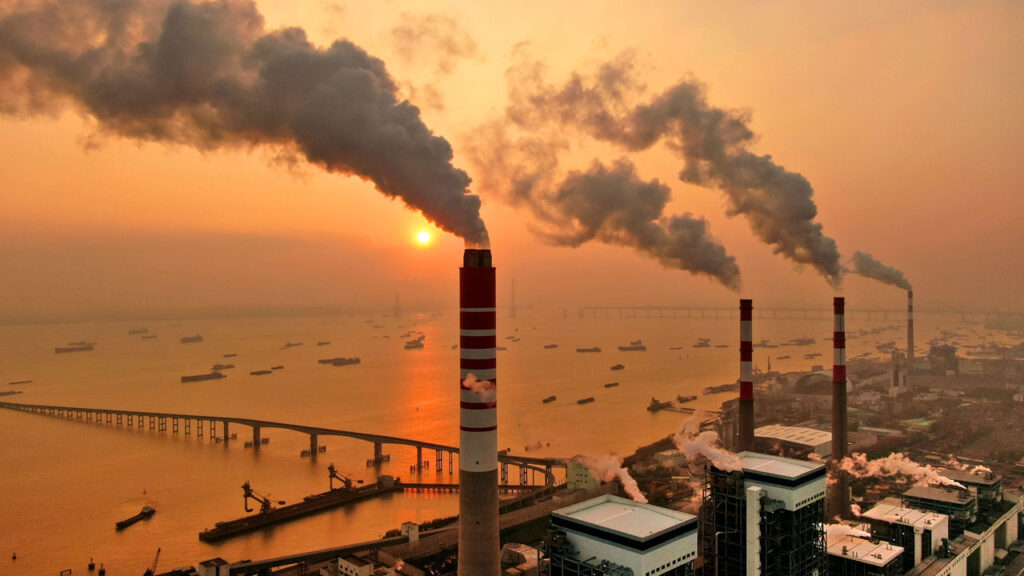
Vietnam is making a clear shift from climate pledges to concrete implementation as the government officially rolls out a pilot program to allocate greenhouse gas emission quotas to key industrial sectors. This is not merely an environmental policy adjustment, but a significant milestone in turning the country’s carbon reduction commitments into real, measurable action on the international stage.
Under a decision signed by Deputy Prime Minister Trần Hồng Hà, total greenhouse gas emission quotas for the 2025–2026 pilot phase will be distributed to 110 facilities across three high-emitting industries: thermal power generation, iron and steel production, and cement manufacturing. Targeting these major emission sources from the outset reflects a focused and practical approach rather than a broad but shallow rollout.
The total quota for 2025 is set at more than 243 million tons of CO2 equivalent, rising to over 268 million tons in 2026. These figures are more than administrative benchmarks. They signal that Vietnam is beginning to assign quantified emission responsibilities to specific sectors and individual facilities, instead of relying solely on national-level targets.
The pilot program includes 34 thermal power plants, 25 iron and steel facilities, and 51 cement plants. These sectors are energy-intensive, emissions-heavy, and central to economic growth. Bringing them into the emissions quota system early on underscores a new development direction for Vietnam, where economic expansion must go hand in hand with environmental responsibility.
The lead agency for implementation is the Bộ Nông nghiệp và Môi trường, working in coordination with the Bộ Công Thương and the Bộ Xây dựng. These bodies are responsible not only for allocating quotas but also for building guidance systems, monitoring mechanisms, and evaluation frameworks to form a transparent and verifiable emissions management foundation.
The core value of the pilot phase lies not simply in the quota numbers themselves, but in establishing a complete carbon management ecosystem. From measurement and inventory to reporting, verification, and certification, the entire process must be standardized on a solid scientific basis and aligned with international practices. This is essential for Vietnam to demonstrate that it can deliver on its climate commitments in a credible and internationally recognized manner.
The first-ever nationwide allocation of emission quotas also serves as a foundational brick for the future carbon market. As enterprises are required to measure and manage their own emissions, they will gradually move away from a “production at any cost” mindset toward one focused on efficiency and low emissions. This shift encourages technological innovation, energy efficiency, and process optimization.
In a global trade environment increasingly shaped by environmental standards, early adaptation to emission quota mechanisms will help Vietnamese businesses strengthen their competitiveness. Companies that cut emissions effectively can lower energy costs and, in the future, benefit from trading surplus allowances or carbon credits. In contrast, those that delay transformation may face rising costs, export barriers, and reputational risks.
The period through 2027 is designated for piloting and institutional refinement. From 2028 onward, emission quota management is expected to be officially and mandatorily applied nationwide to all facilities subject to greenhouse gas inventory requirements. The current pilot phase therefore acts as a critical runway, allowing both regulators and businesses to become familiar with the new “rules of the game” in a low-carbon economy.
Quotas for each facility will be determined based on multiple factors, including emissions per unit of product, sectoral growth targets, business production plans, mitigation potential, and each enterprise’s technological and financial capacity to reduce emissions. This approach creates incentives for technological improvement and production model innovation, rather than simply imposing administrative limits.
More importantly, the mechanism directly links economic interests with environmental responsibility. When emissions become a measurable and tradable “cost,” investing in clean technologies, energy efficiency, and green transformation is no longer a symbolic choice. It becomes a core strategy for long-term survival and sustainable growth.
The pilot allocation of emission quotas is therefore not only about controlling pollution. It opens a new pathway for Vietnam’s economy, enabling domestic enterprises to align with global green development trends while contributing to the protection of ecosystems and the quality of life for future generations.
Source: Vneconomy
