

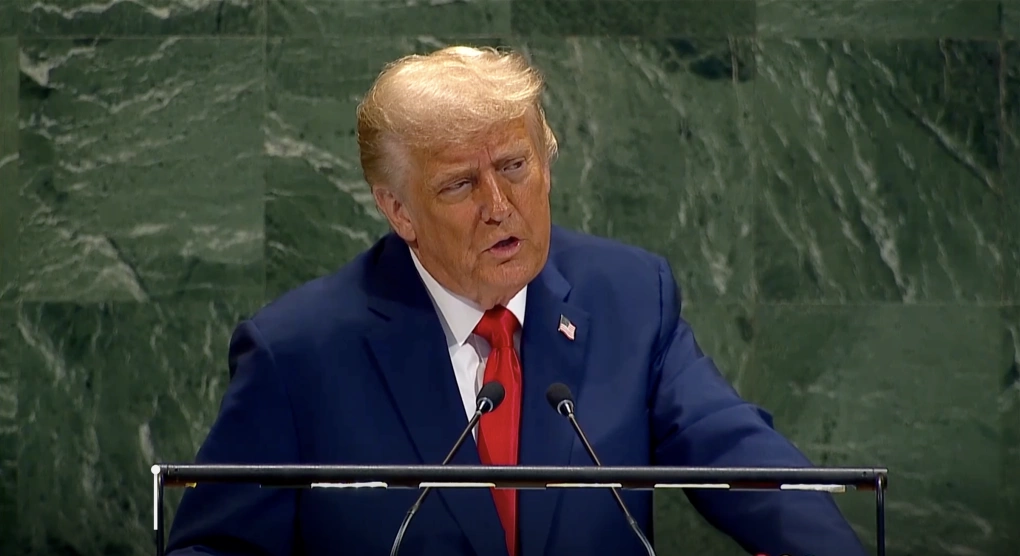
Introduction: A Shockwave of Denial at the United Nations
Amid global efforts to address an escalating climate crisis, President Donald Trump’s declaration that climate change is a “hoax”—made during a pivotal session of the United Nations General Assembly—triggered an immediate and potent backlash. The statement was not merely a political posture but a direct repudiation of established climate science, drawing swift condemnation from political leaders, scientists, and experts from the world’s most vulnerable regions. This article analyzes the core arguments used to counter Mr. Trump’s claims, contrasting his rhetoric with scientific evidence, international consensus, and the lived reality of climate change impacts.
I. Political Outrage and the Reality of Vulnerable States
The strongest and most visceral counter-arguments came from leaders on the front lines of climate impacts, most notably from the state of California.
Governor Gavin Newsom: “A Disgrace”
California Governor Gavin Newsom, attending Climate Week in New York, labeled President Trump’s dismissal of climate change as a “disgraceful” act. Newsom’s critique was grounded in the immediate and severe reality facing his state: “I say this as someone who lives in one of the most crisis-prone states in America. This is a place that has seen so many historical sites, traditions, and ways of life completely destroyed by climate change,” Newsom told Hindu.
The response highlights the profound chasm between federal and state-level policy. California, grappling with historic droughts, catastrophic wildfires, and rising sea levels, announced a new climate partnership initiative, signaling its unwavering commitment to climate action irrespective of the federal government’s stance. This is a battle not over abstract theory but over the concrete destruction of communities and livelihoods.
Voices from the Most Vulnerable
The condemnation extended beyond U.S. borders. Adelle Thomas, Vice-Chair of the UN Intergovernmental Panel on Climate Change (IPCC) and a native of the Bahamas—a highly vulnerable Caribbean region—recalled Hurricane Sandy, which devastated the Caribbean and New York City over a decade ago. Her call for urgent action underscored how Trump’s rhetoric appears as indifference to the existential threat faced by low-lying island nations and coastal communities globally. For these regions, climate change is not a political debate but a matter of immediate survival.
II. The Scientific Rebuttal: Debunking the ‘Global Warming’ Semantic Shift
One of Mr. Trump’s key arguments was that scientists changed the term from “global warming” to “climate change” to mask inaccurate past predictions. “They said global warming will kill the world, but then it started getting cooler. So now they could just call it climate change, because that way, they can’t miss. It’s climate change, because if it goes higher or lower, whatever the hell happens, there’s climate change,” he asserted.
The Scientific Fact (NASA and IPCC Rebuttal):
The shift to “climate change” is not a cover-up but a move toward greater scientific accuracy. The U.S. National Aeronautics and Space Administration (NASA) defines the term as the broader changes happening across the planet, of which “global warming” (the increase in average surface temperature) is only one symptom. Climate change encompasses:
- Rising sea levels.
- Accelerated ice melt in Greenland, Antarctica, and the Arctic.
- Changes in flowering times for plants.
- Increased frequency and intensity of extreme weather events.
According to the 2023 IPCC report, the scientific evidence is conclusive: human activities causing greenhouse gas emissions have unequivocally led to global warming. Global temperatures between 2011 and 2020 were 1.1∘C higher than the 1850–1900 average. Scientists warn that continued emissions will only accelerate this trend. The data demonstrates that this is a quantifiable, human-driven crisis, not a linguistic trick.
III. The Failed Prediction vs. Real-World Displacement
Mr. Trump also attempted to discredit the UN by referencing a specific, inaccurate prediction from 36 years ago, where a UN official suggested certain nations would be “wiped off the map” by climate change by the year 2000.
While the exact prediction did not materialize, news outlets like CNN and Time countered that focusing on this historical error ignores the crisis’s contemporary magnitude:
- The Crisis is Here: The climate catastrophe has resulted in the displacement of 220 million people over the last decade, according to scientific estimates. This demonstrates that while the timing or specifics of one prediction may have been wrong, the large-scale humanitarian and environmental disaster is very real.
- Environmental Degradation: Climate change is causing ice to melt and forcing species like penguins to change nesting locations, as observed in Antarctica. The crisis manifests as mass migration, loss of biodiversity, and colossal economic damage—not merely in the way predicted decades ago, but through pervasive and compounding effects.
The Political Weaponization of Science
Time magazine noted that Trump’s speech was part of a pattern by his administration to downplay the threat of climate change in the public consciousness. This was starkly evident in a recent Department of Energy (DOE) report that claimed climate change would be “less damaging economically than commonly believed.”
Crucially, this DOE report was denounced by over 85 scientists who accused officials of deliberately cherry-picking facts and figures to serve the administration’s pro-fossil fuel agenda. This incident highlights the effort to politicize and manipulate scientific data to justify policy decisions.
IV. Policy Fallout: Retreat from Global Cooperation
Mr. Trump’s denialist rhetoric is consistently backed by policy actions that seek to dismantle climate regulations and retreat from international commitments.
Rolling Back Environmental Regulations
Since taking office for a second term (as implied in the original text), Mr. Trump has prioritized the rollback of environmental regulations:
- Paris Agreement: He withdrew the U.S. from the Paris Climate Accord on his first day in office.
- EPA and Emissions Reporting: The Environmental Protection Agency (EPA) proposed scrapping a rule requiring businesses to inventory and report greenhouse gas emissions, a move that minimizes corporate accountability and promotes the continued use of fossil fuels.
These actions send a clear signal: the administration prioritizes short-term economic gains and domestic fossil fuel production over environmental stewardship and long-term global sustainability.
Strain on Multilateral Relations
Mr. Trump’s UN address also reflected a broader skepticism toward multilateral institutions.
| Issue | Trump Administration Action | Analysis |
| UN Funding | Reduced the U.S. budget for the UN by 1 billion and planned a further 1 billion cut. | Despite providing 13 billion in support in 2023, the cuts indicate a deep skepticism toward UN operations and a reduction in U.S. financial commitment. |
| Membership | Withdrew the U.S. from the World Health Organization (WHO) and planned to leave UNESCO. | These moves emphasize a turn toward isolationism and a rejection of long-standing international cooperative frameworks. |
While Trump’s first UN address in 2018 was met with diplomatic unease, CNN noted that his later speech elicited applause and praise. This shift suggests either a change in global political alignment, where some nations seek accommodation with the powerful U.S., or an endorsement of policies that reduce environmental regulatory burdens.
Conclusion: Science vs. Political Expediency
Donald Trump’s characterization of climate change as a “hoax” is a direct challenge to the consensus of the global scientific community.
The forceful rebuttals from Governor Newsom, IPCC experts, and independent scientists confirm that:
- Climate change is a physical reality, evidenced by a measured 1.1∘C temperature increase and its comprehensive consequences (sea-level rise, ice loss, extreme weather).
- The focus should be not on a single erroneous prediction from 1989 but on the 220 million people displaced in the last decade due to the climate crisis.
Mr. Trump’s policy choices—prioritizing fossil fuels, dismantling regulations, and abandoning international agreements—pose a formidable obstacle to the necessary global shift toward sustainability. The question for the international community remains whether the world’s largest economy can indefinitely detach itself from this collective responsibility without risking irreversible harm to the planet and to its own standing as a global leader.
