India’s e-waste recycling sector has grown into a $1.56 billion industry by 2023, fueled by booming consumer demand for electronic devices and government incentives. Yet behind this impressive growth lies a “dark side” — where millions of impoverished workers labor in hazardous conditions for meager pay, operating almost entirely outside the legal system.
A Vast Informal Economy
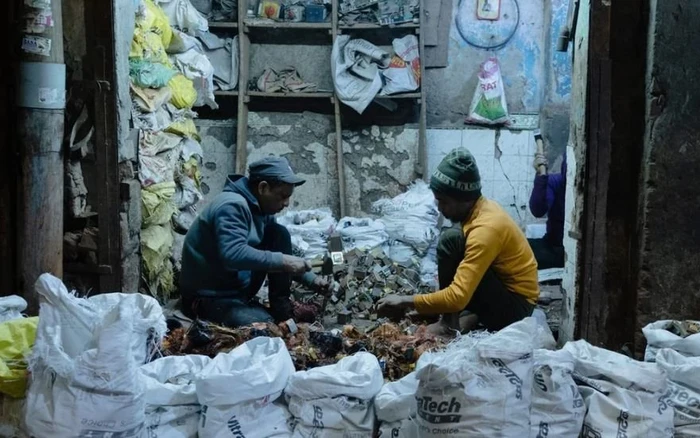
India is currently the world’s third-largest generator of electronic waste, producing 1.75 million tons in fiscal year 2024 — nearly 75% higher than five years ago. About 60% of this waste is not processed formally, instead flowing into informal networks such as those in Delhi’s Khatta district. There, workers manually dismantle, burn, and strip wires in toxic conditions, often earning just a few dollars a day.
An estimated one million people make their living in this informal sector, accounting for 95% of the labor force in e-waste recycling. Most of the profits, however, go to middlemen and powerful families such as the Maliks, who control as much as 83% of the recycling trade in hotspots like Seelampur.
Policy vs. Reality
Since 2011, the Indian government has rolled out regulations aimed at bringing e-waste processing into the formal sector, requiring manufacturers to collect and recycle through licensed facilities. In 2022, a new “recycling credit” mechanism was introduced, offering financial incentives similar to carbon credits. Modern recycling firms such as Attero and Recyclekaro have benefited significantly.
Still, according to Satish Sinha, Deputy Director of the Delhi-based nonprofit Toxics Link:
“Most personal e-waste — phones, screens, small appliances — continues to flow into the informal sector. Current legal frameworks have not fundamentally changed people’s habits or the economic incentives driving the system.”
Many global corporations, including Samsung, LG, and Hitachi, have resisted the regulations, citing increased compliance costs. Meanwhile, informal operators largely ignore the rules, as legal compliance would mean paying taxes and losing profits.
A Global Challenge
The problem is not unique to India. A United Nations Environment Programme (UNEP) report highlights that the world generates over 62 million tons of e-waste annually, with less than 20% processed properly. Informal recycling sectors thrive not only in India but also in Ghana, Nigeria, and parts of China.
Jane Stewart, an environmental expert at Oxford University, explains:
“India faces the same dilemma as many emerging economies: how to balance the massive economic potential of e-waste with the urgent need to protect public health and the environment. Without decisive policy and enforcement shifts, the long-term consequences will be dire — from soil and water contamination to rising healthcare burdens.”
Meanwhile, Michael O’Connell of the Basel Action Network (USA) believes India could become a global recycling hub:
“India has the labor force and abundant waste streams. With the right investments, the country could build a world-class recycling sector, creating hundreds of thousands of safe jobs and recovering critical minerals for high-tech manufacturing.”
The Future: Two Diverging Paths
In mid-2025, authorities shut down the Khatta site, signaling tougher enforcement. Yet many observers believe the informal network will simply relocate rather than disappear. Still, the closure marks a potential turning point for India’s e-waste landscape.
The future of the industry stands at a crossroads:
- If informality continues: India risks mounting environmental and health crises, with escalating social costs.
- If formalization succeeds: India could become a global model, transforming “waste” into a sustainable “urban mine.”
To achieve this, international experts recommend India should:
- Strengthen collection at the source, encouraging citizens to channel e-waste into formal systems.
- Provide training and alternative livelihoods for informal workers.
- Attract global investment in green recycling technologies, reducing reliance on toxic manual labor.
The shadows of India’s e-waste industry remain, but with bold action, the country could turn this challenge into an opportunity — not only for itself but for the entire world.
